

Industrial PhD projects give companies something their normal operations rarely allow for: someone working on problems that won’t matter until years from now.
Fredrik Nordin has worked on autonomous trucks at Scania for eight years and is currently an associate senior engineer. He knows how organizations work. “In software development, it can be short-sighted — you always do the short-term and maybe some medium-term developments, but you don’t really think about the long term,” he says.
The industrial PhD, in his view, is one of the few mechanisms that create space for a different scope of thinking.
“Someone can work five years on one thing and dig really deep into it and find: does it work, does it not work, when does it work, when does it not?” he says. “Maybe four years later, we realize, oh, we should have started this five years ago. And then a PhD actually did start it five years ago and knows everything about it.”

A perspective industry can’t easily build on its own
Christian Berger, professor of computer science at the University of Gothenburg, describes the dynamic as one that benefits both sides when it functions well.
“I’m genuinely convinced that academic research can be very fruitfully complemented by close collaboration with industry,” he says. “Both sides can benefit tremendously. Industry stays on top of what is going on in research, and academia benefits a lot from industry and their day-in, day-out challenges.”
Mårten Lager, named WASP Alumn of the Year 2025 and now leading a team of eight at Saab working on autonomous maritime systems, came to WASP as an industry veteran with years at Saab Kockums behind him. He describes the gap his PhD filled precisely.
“I was very interested in new technology. I saw all these kinds of opportunities in the military domain, but I didn’t have the knowledge to really do something about it. I couldn’t talk in a good way to my managers about it.”
The PhD gave him the language to act on what he could already see.
Balancing the long-term and short-term
The challenge of operating across different time scales is not only a company problem. Students can experience it too, from a different direction.
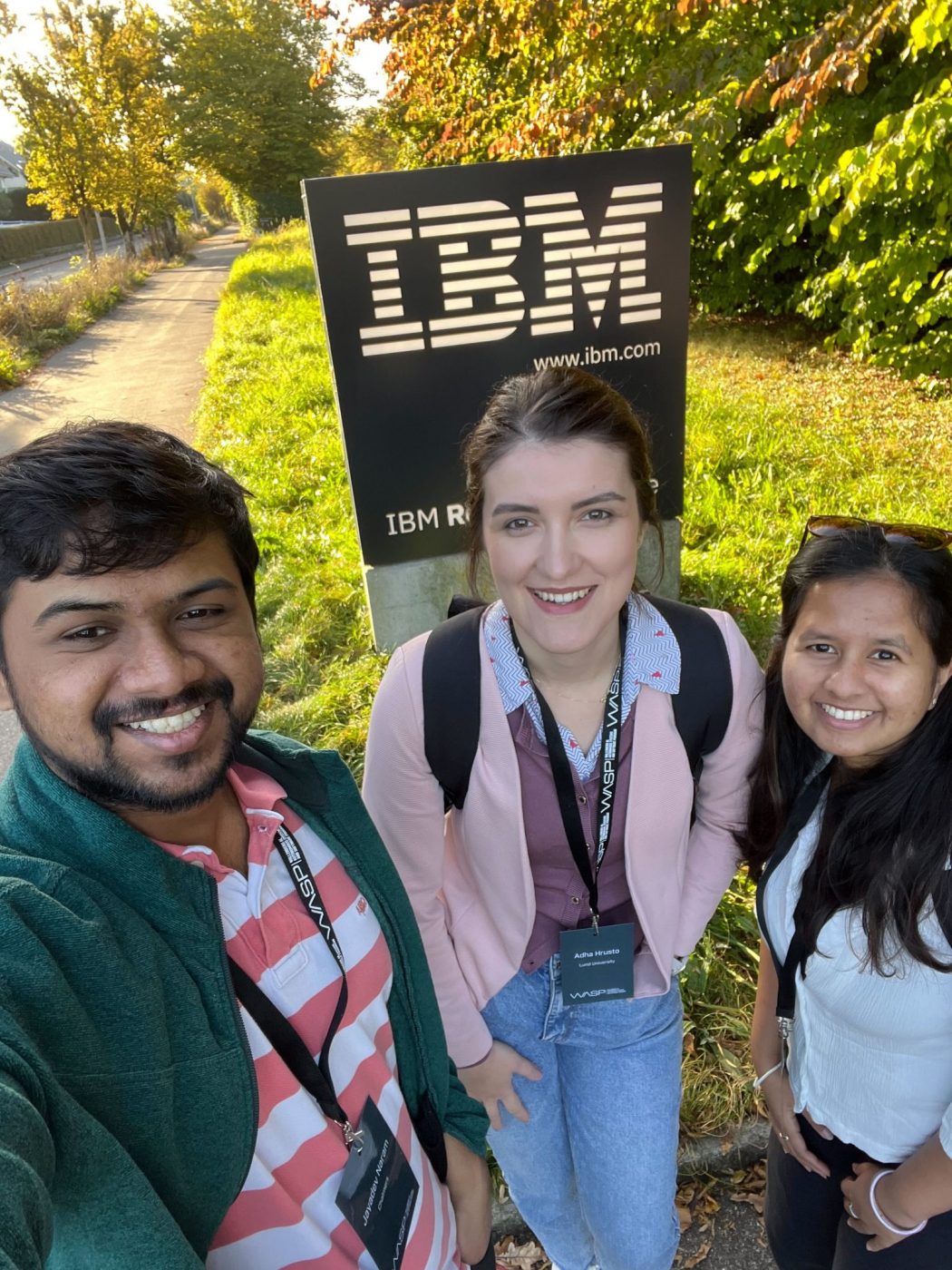
Adha Hrusto, who completed her industrial PhD at Lund University in November 2024, describes the early years of doctoral work as a period when the pressure to show results can run against the nature of research itself.
“It can be hard to show some tangible results in the beginning when your colleagues are asking you how it is going,” she says.
Her advice to future students is to focus on one step at a time, especially when it is hard to see the whole picture or imagine how the PhD will unfold over five years.
“Just trust the process and keep going step by step. It can feel overwhelming to look too far ahead. Try to focus on the next step and on what you can do in this moment.”
There is interesting asymmetry here. Where industry insider Fredrik sees the PhD student as the person freed from short-termism, Adha experienced the opposite pull — the need to resist thinking too far ahead and stay grounded in what could be done today. Both pressures are real, and they reflect the different vantage points of company and student within the same collaboration.
Long-term investment, long-term return
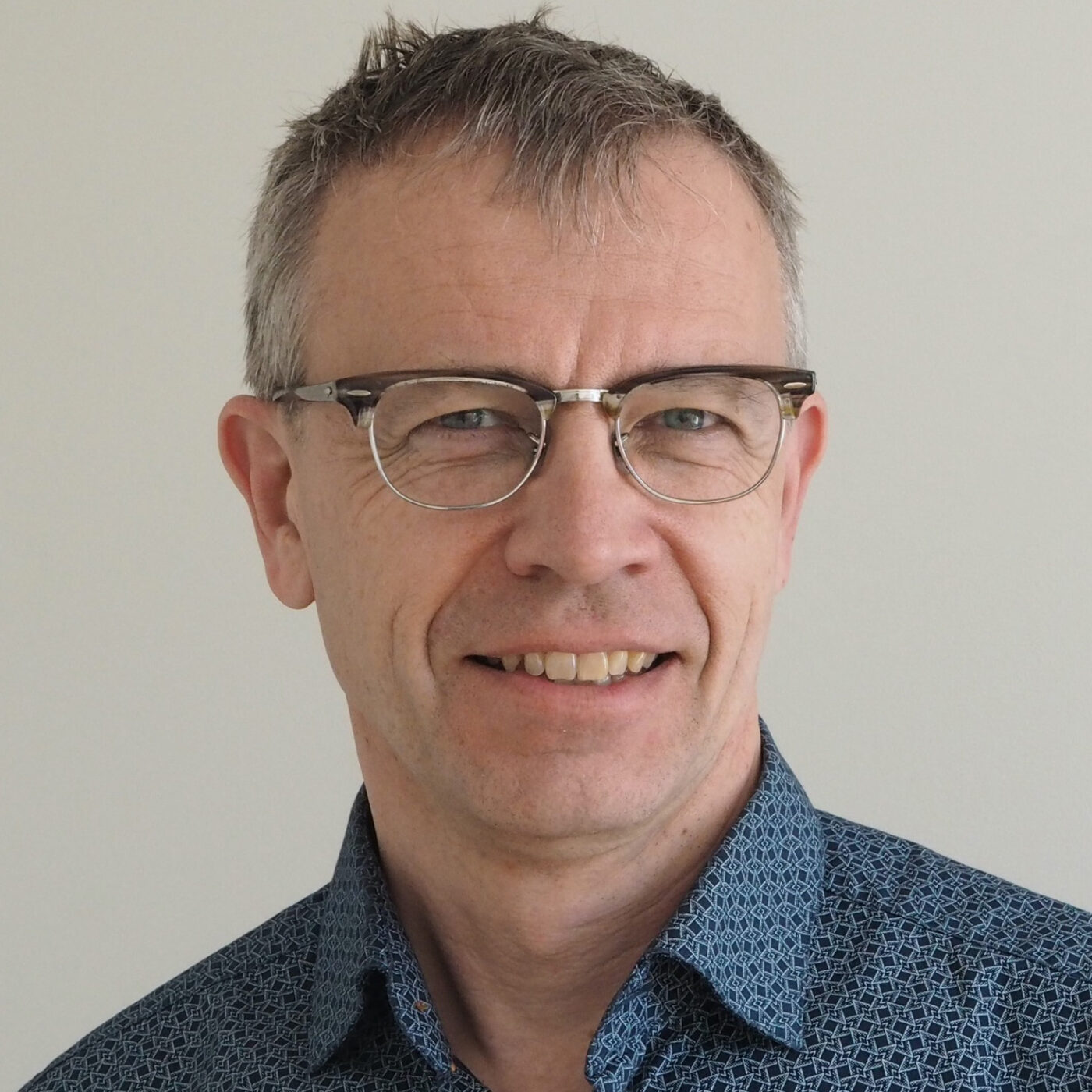

Frida Norlund.
Per Runeson, professor of software engineering at Lund University, has supervised industrial PhD projects for nearly two decades and has watched how academic and industrial timelines interact in practice. “The industry goals are more short-term or near-term, while academia works towards the more long-term, slow thought processing,” he says. “But there can be mutual benefits if there is respect.”
The key is not pretending the tension doesn’t exist but acknowledging it and designing the project accordingly. “If you don’t agree, there might be conflicts and you might miss the opportunities. On the other hand, if you understand each other, you can set up the project, so you get mutual benefits.”
Frida Norlund, who completed her industrial PhD with Boliden, describes her motivation in terms of long-term planning. “The main driver for me is the question ‘how is this going to be applied?’ The context is very important to me and motivates me. That’s why an industrial PhD suits me well.”
The personal dimension
For Fredrik, working alongside and supervising Vandana Narri’s PhD project has had an effect beyond research outputs. Being involved in long-term work while operating inside an organization otherwise focused on immediate delivery is, he says, opens up new types of thinking for him. “When you’re locked down to these deadlines and everything and then you have one day a week where you work on this other long-term thing — I think that’s definitely a personal advantage.”
Nikolaos Pappas, associate professor at Linköping University, sees a parallel shift play out as a project matures. In the early months, research direction is set primarily by the supervisors. Over time, the student takes the wheel.
“Now the student has started showing some initiative to move it further. He comes with his own ideas. Even though the first paper is very close to completion, we have a plan for a second and third one that also now seems to be driven by the student, which is nice.” That shift, Nikolaos says, is one of the markers of a successful industrial PhD: “The student becomes independent thinker and creates new ideas.”
This article is the second part of a series exploring the journey of a WASP industrial PhD. It provides insight into the experiences of both industrial PhD students and their supervisors, including their perspectives on opportunities, challenges, and potential career paths. In the next article, we take a closer look at life after an industrial PhD. Read the first article here.
Published: August 17th, 2026
[addtoany]