

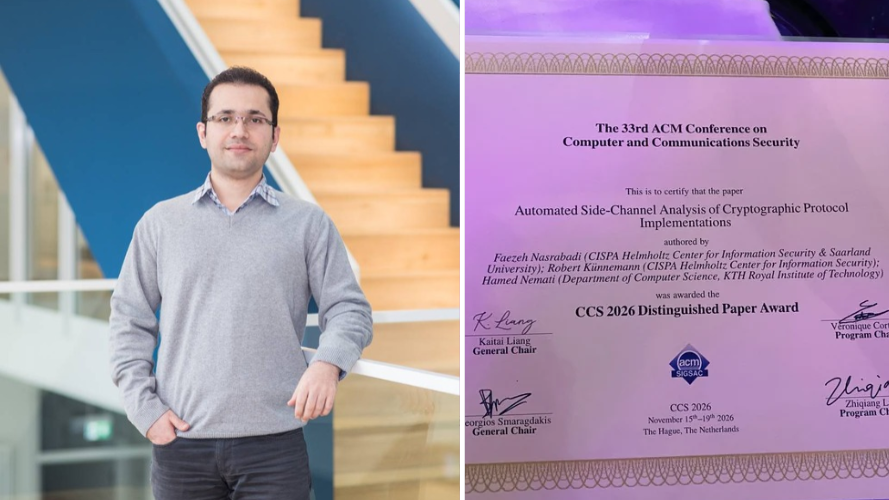
WASP Fellow Hamed Nemati from KTH Royal Institute of Technology has received a Distinguished Paper Award at ACM CCS, one of the leading international conferences in computer security and privacy. The award-winning research demonstrates how patterns of computer activity can reveal who someone has previously communicated with, without accessing the content of their messages.
Who you communicate with can be just as private as what you say. Even when messages are encrypted, the way an application runs on a computer can leave behind clues that reveal private information.
To investigate these potential privacy leaks, Hamed Nemati and his co-authors developed a method to detect information exposed through patterns of computer activity. When examining WhatsApp, they found that someone observing these patterns could determine whether a user had previously communicated with a particular person, without reading a single message.
The research builds on CryptoBAP, a tool developed during the PhD studies of Faezeh Nasrabadi, the paper’s first author. Nemati supervised Nasrabadi during her PhD at CISPA Helmholtz Center for Information Security.
Investigating hidden privacy risks
At KTH, Nemati’s research group studies how software can unintentionally reveal private information through the way it operates. The group develops mathematical tools to identify potential information leaks and verify whether software provides the protection it was designed to deliver.
The research received a Distinguished Paper Award at ACM CCS (Conference on Computer and Communications Security), the flagship annual research conference of ACM SIGSAC.
“For me, the most rewarding part is seeing an idea we developed during Faezeh’s PhD uncover a privacy issue in an app people use every day. It means a great deal to see that work recognized by our peers, and I am grateful to WASP for supporting it,” says Hamed Nemati.
Published: November 23rd, 2026
[addtoany]