

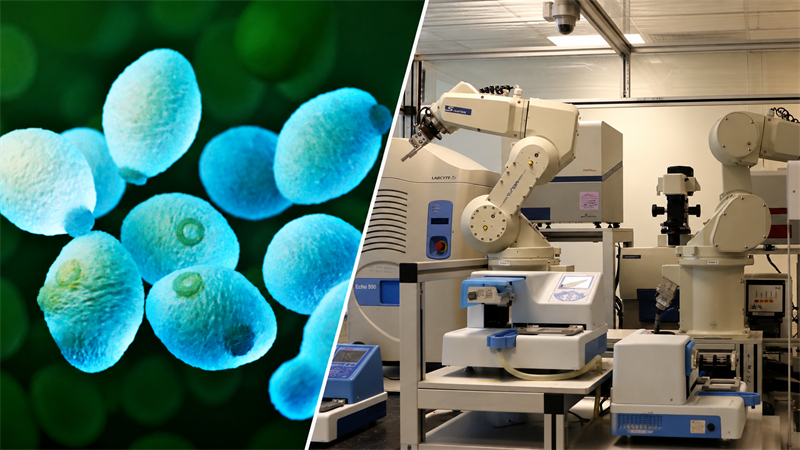
Researchers at Chalmers University of Technology have developed an AI scientist capable of generating hypotheses, designing experiments and interpreting results with minimal human intervention. The WASP-funded study shows how autonomous laboratories could accelerate biological discovery.
By combining large language models, automated reasoning and laboratory automation, the researchers created a closed-loop AI laboratory that conducts research on brewer’s yeast. Drawing on extensive scientific knowledge, the system was able to identify promising biological questions, propose experiments and refine its understanding based on new evidence.
According to the researchers, autonomous laboratories have the potential to accelerate discoveries across biology, medicine and biotechnology by carrying out routine cycles of hypothesis generation and experimental testing far more rapidly than is possible today.
While AI systems are becoming increasingly capable research partners, the researchers emphasise that they are intended to augment rather than replace scientists. Human researchers remain essential for setting research priorities, interpreting scientific significance and ensuring ethical oversight.
The authors of the study are Daniel Brunnsåker, Alexander H. Gower, Prajakta Naval, Erik Y. Bjurström, Filip Kronström, Ievgeniia A. Tiukova and Ross D. King. The researchers are affiliated with Chalmers University of Technology, the University of Gothenburg and the University of Cambridge in the UK.
The study, Agentic AI integrated with scientific knowledge: laboratory validation in systems biology, was partly funded by WASP and published in the Journal of the Royal Society Interface.
Read more
Published: October 1st, 2026
[addtoany]