Academic freedom under pressure – perspectives on diversity, inclusion and AI
December 1 @ 15:00 – 16:30
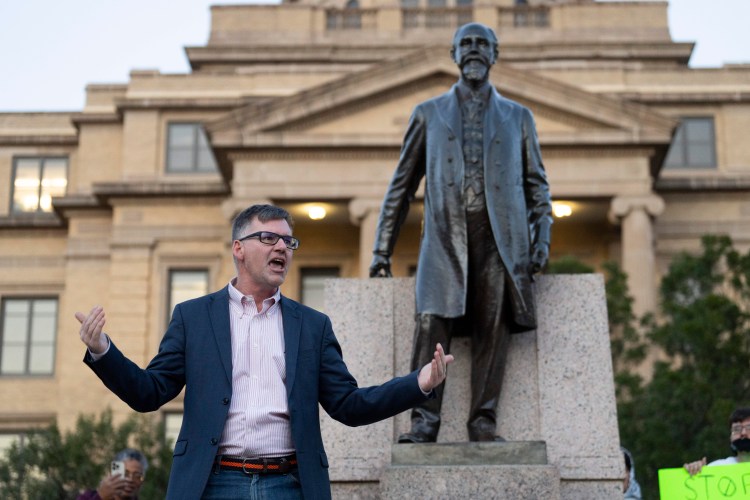
Welcome to a digital event arranged by the WASP Diversity and Inclusion Group (DIG) with Martin Peterson, Professor of Philosophy at Southern Methodist University, Texas.
Martin Peterson’s research focuses on AI ethics, the ethics of technology, normative ethics and decision theory, with a particular interest in the philosophical questions raised by emerging technologies.
Before joining Southern Methodist University, Peterson was Professor of Philosophy at Texas A&M University from 2014 to 2026. He has also held academic positions at Eindhoven University of Technology and the University of Cambridge.
When Martin Peterson was prevented from teaching passages from Plato’s Symposium at Texas A&M in 2026, the case made headlines around the world. Drawing on this experience and his work as Chair of the Academic Freedom Council at Texas A&M, Peterson will explore academic freedom, institutional censorship and the ethical choices available to scholars facing unreasonable restrictions. He also reflected on the case in his 2026 episode of Swedish Radio’s Sommar i P1 (see external links under Read more).
The talk will be followed by a conversation with Ericka Johnson, Professor in Gender and Society at Linköping University. Participants will have an opportunity to submit questions during the talk via Q&A.
- Date and time: 1 December, 15.00-16.30
- Venue: This is a digital event, please find the Zoom link at the top of this page.
The event is open to the public, and no registration is required. Mark your calendars and join the conversation!
Program
Part 1: Plato and the Ethics of Permissible Resistance
Guest: Martin Peterson
This talk is based on Martin Peterson’s personal experience as Chair of the Academic Freedom Council at Texas A&M University (2024–2026). He considers the following question: How should students and faculty respond to institutional censorship? Using Texas A&M’s decision to censor Plato as a case study, he identifies four possible responses: anticipatory obedience, civil disobedience, malicious compliance, and what he calls dissenting compliance. Anticipatory obedience—conforming to perceived expectations before being explicitly required to do so—is morally problematic because it reinforces and extends censorship. Civil disobedience, while admirable in many political contexts, may be less justifiable in academia when its expected benefits are small compared with the substantial personal and professional risks. Malicious compliance avoids capitulation but depends on deliberately disruptive, bad-faith adherence to rules. Peterson argues instead for dissenting compliance: complying with institutional policies while explicitly and publicly expressing principled disagreement with them. Ideally undertaken with a light touch and, at times, humor, dissenting compliance can expose unreasonable constraints without sacrificing professionalism.
Part 2: Academic censorship in the age of AI
Guest: Martin Peterson
Moderator: Ericka Johnson, Professor in Gender and Society, Linköping University
Conversation with Martin Peterson and Ericka Johnson, followed by a Q&A.