



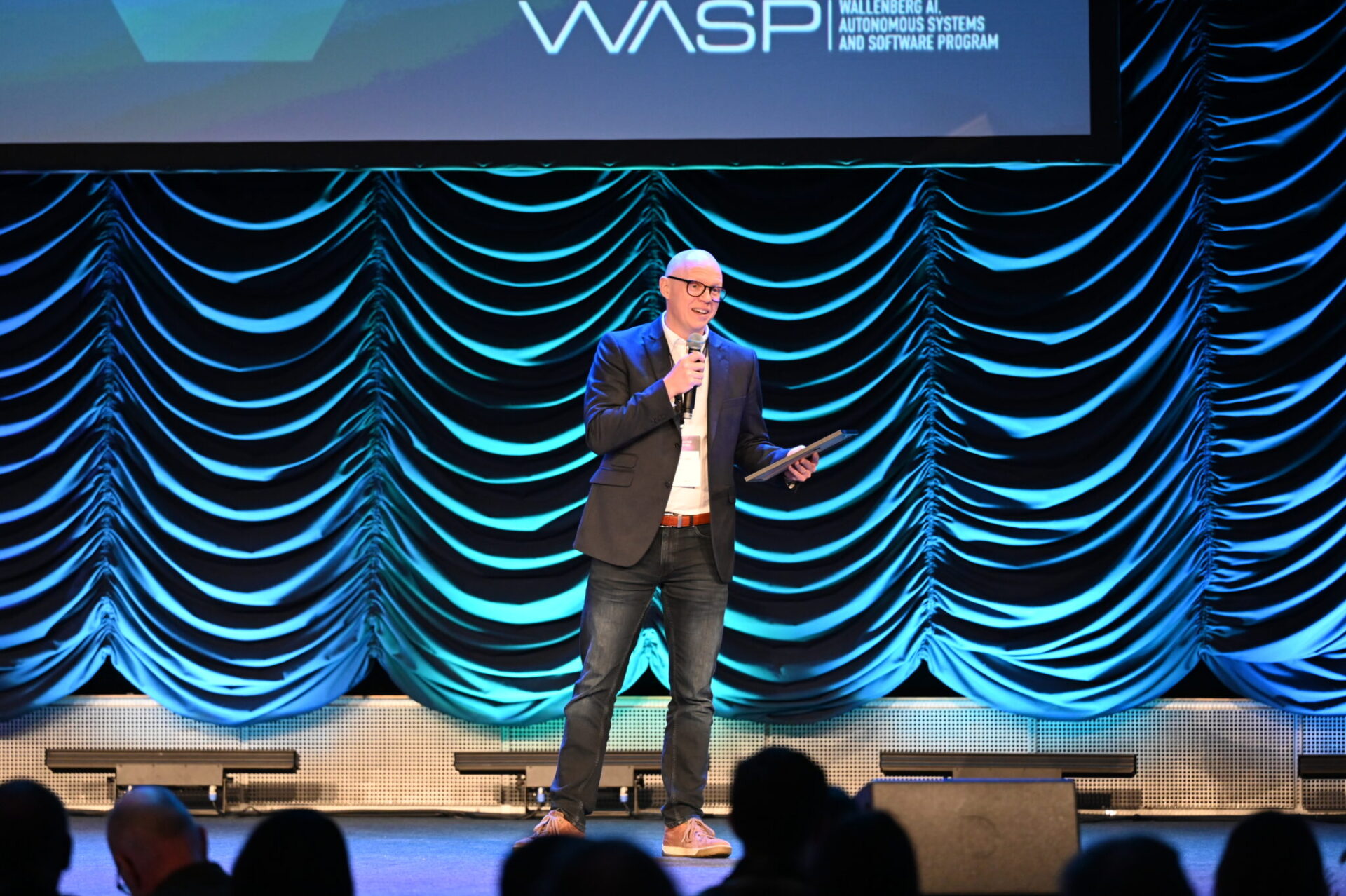
At the WASP Winter Conference 2026, held in Örebro January 14-15, Mårten Lager was named as the Alum of the Year for 2025. Read about his background and research here.
When Mårten Lager joined WASP as part of its very first cohort of PhD students, he was already an industry veteran. With a background as a submarine officer and many years at Saab Kockums, he brought a deep understanding of real-world systems, sensors, and operational constraints. What he lacked, he says, was the language and tools to shape the future he could already glimpse.
“I was very interested in new technology,” Lager explains. “I saw all these kinds of opportunities in the military domain, but I didn’t have the knowledge to really do something about it. I couldn’t talk in a good way to my managers about it.”
That gap is what ultimately led him to WASP.
A different kind of PhD journey
Unlike many doctoral students who move from academia into industry, Lager took the opposite route. After years in industry, he joined WASP’s Autonomous Systems track as a PhD student, while also raising young children and adjusting to academic life.
“Coming from industry and having small kids, it was a bit of a shock,” he recalls. “But it was really fun to get acquainted with all these new technologies: autonomous systems, AI, all these techniques.”
His industrial background shaped how he approached research. Instead of starting from abstract problems, he worked from real-world needs—what works, what fails, and what actually matters in practice.
“During WASP, I had all the knowledge in the back of my head from industry,” he says. “That was very valuable for me.”
Navigating without GPS
One of the defining directions of Lager’s PhD research was GNSS-denied navigation: how to determine a vessel’s position when GPS is unavailable or unreliable.
“During the war in Ukraine, it has become quite obvious why this is so important. GPS can be jammed very easily,” says Lager. “And you can even be spoofed, fooled into thinking you’re in the wrong location.”
Rather than following established approaches, Lager turned the problem around. Much of the existing research assumed low-quality sensors paired with highly accurate maps. In real military settings, he explains, the situation is often reversed.
“We have great sensors, really expensive sensors, but not that great maps of the seabed,” he says.
Through WASP’s test arenas—particularly the WARA Public Safety (WARA PS)—Lager was able to move beyond simulations and test his ideas in real-world environments.
From research to reality
After completing his PhD, Lager returned to Saab with new tools, new confidence, and a clearer sense of direction. He began by focusing on computer vision at sea, identifying it as an area where meaningful progress could be made quickly.
By demonstrating early results, he was able to build momentum, recruit colleagues, and grow a team. Today, he leads a team of eight working on computer vision, sensor fusion, and autonomous functions for maritime systems.
The team conducts continuous real-world testing, operating research vessels and collecting new data in challenging environments.
“I’m out at sea once every second week or so, doing testing on the boat,” Lager says.
Autonomy as support, not replacement
For Lager, autonomy is not about removing humans from the loop, it’s about empowering them.
“Autonomy doesn’t have to mean unmanned,” he says. “It can also be decision support.”
He points to everyday examples such as modern cars that can brake automatically or assist drivers in dangerous situations. In safety-critical systems, he believes this kind of functional autonomy will become increasingly important.
“You don’t automate the whole system,” he explains. “You automate functions.”
This human-centered view of autonomy has become a defining feature of his work, both in research and in practice.
A lasting connection to WASP
Despite returning full-time to industry, Lager has remained deeply connected to the WASP community. He now serves as an industrial supervisor for a WASP PhD student, continues collaborations through WASP’s test arenas, and regularly attends WASP events. He also recruited a colleague from the first batch of WASP PhD students to join his team.
For Lager, however, the most lasting impact of WASP is cultural rather than technical.
“Going through WASP felt like a big journey,” he says. “You start this journey together with colleagues. You talk about AI, autonomy, robotics all the time. You’re in this bubble where you start becoming part of the future.”
That mindset, he believes, gives WASP alumni a unique long-term perspective.
“I believe most WASP students are really good at predicting what the future will look like 10 years ahead.”
Lager said he is flattered to be named WASP Alumni of the Year.
“In WASP, everyone is so extremely skilled,” he said.
For WASP, the award recognizes not only Lager’s technical achievements, but also his ability to bridge academia and industry. This includes his research into systems that matter, mentoring the next generation, and shaping how autonomy is understood and deployed.
Published: January 15th, 2026
[addtoany]