Wallenberg Advanced Scientific Forum – Autumn 2026
Welcome to the Wallenberg Advanced Scientific Forum, Autumn 2026 – Symmetries in Neural Networks.
Plese note, to attend this conference, a personal invitation from the organizers is required.
Time: September 29-October 2
Venue: Rånäs Castle (Rånäs slott), Stockholm county
Organizers
Fredrik Kahl, Chalmers University of Technology
Axel Flinth, Umeå University
Jan Gerken, Chalmers University of Technology
Kathlén Kohn, KTH Royal Institute of Technology
Research Area
Neural networks have consistently outperformed expectations based on current mathematical and computational understanding, raising the question of why they work so well. Over time, symmetries have emerged as a key concept for understanding the behavior and performance of these models. However, different kinds of symmetries all seem to be intertwined: symmetries in data shape what models learn, while symmetries in weight space influence representational capacity, and both induce symmetries in the training dynamics, and vice versa.
The goal of this workshop is to develop systematic tools to 1) identify and compute the various kinds of symmetries, and 2) determine their positive and negative effects on training and generalization, and map out the possibilities that symmetries bring to design energy efficient and reliable AI systems for the future.
These ambitious objectives require interdisciplinary backgrounds in mathematics, computer science, physics, and engineering. Thus, this workshop will bring together world-leading neural-network experts, ranging from mathematical theorists to experts in empirical studies and machine learning practitioners.
Topics
The goal of this workshop is to develop systematic tools to:
- identify and compute symmetries in data, parameter spaces, and training dynamics, and characterize their interconnections,
- determine the positive and negative effects of the various kinds of symmetries on training and generalization, and analyse whether symmetries should be reduced or embraced in theory and practice; in particular, map out the possibilities that symmetries bring to the design of energy efficient and reliable AI systems for the future.
Pre-workshop
A few weeks before the workshop, we will host an online pre-workshop where participants can introduce themselves, start conversations, propose topics, suggest open problems to discuss, and help shape the agenda for the workshop.
Workshop Structure
The workshop is highly interactive and centered on collaborative problem solving. Each topic begins with small-group sessions tackling concrete, scaled-down open problems, followed by selected expert talks that allow participants to engage with existing methods and identify limitations and next steps.
We run two such blocks—one per topic—plus a third problem-solving round for new questions emerging during the workshop. Toward the end, panel discussions will synthesize insights into concrete guidelines on leveraging symmetries for model performance, efficiency, and reliability.
In the final session, we summarize key findings and plan a joint white paper collecting the state of the art, open problems, and research directions identified during the workshop.
Transport
To make your stay as smooth as possible, we offer a free bus transport between Arlanda Airport and Rånäs Castle. An invitation to register for the bus is sent out to registered participants.
If you prefer to travel by taxi, it is approximately a 25 minutes ride from Arlanda. Cost and arrangement of taxi is at your own expense. For the return trip, please contact the reception desk at Rånäs Castle at least 24 hours before departure, and they will help you with the booking.
For directions to Rånäs Castle, visit: https://www.ranasslott.se/en/how-to-find-us/
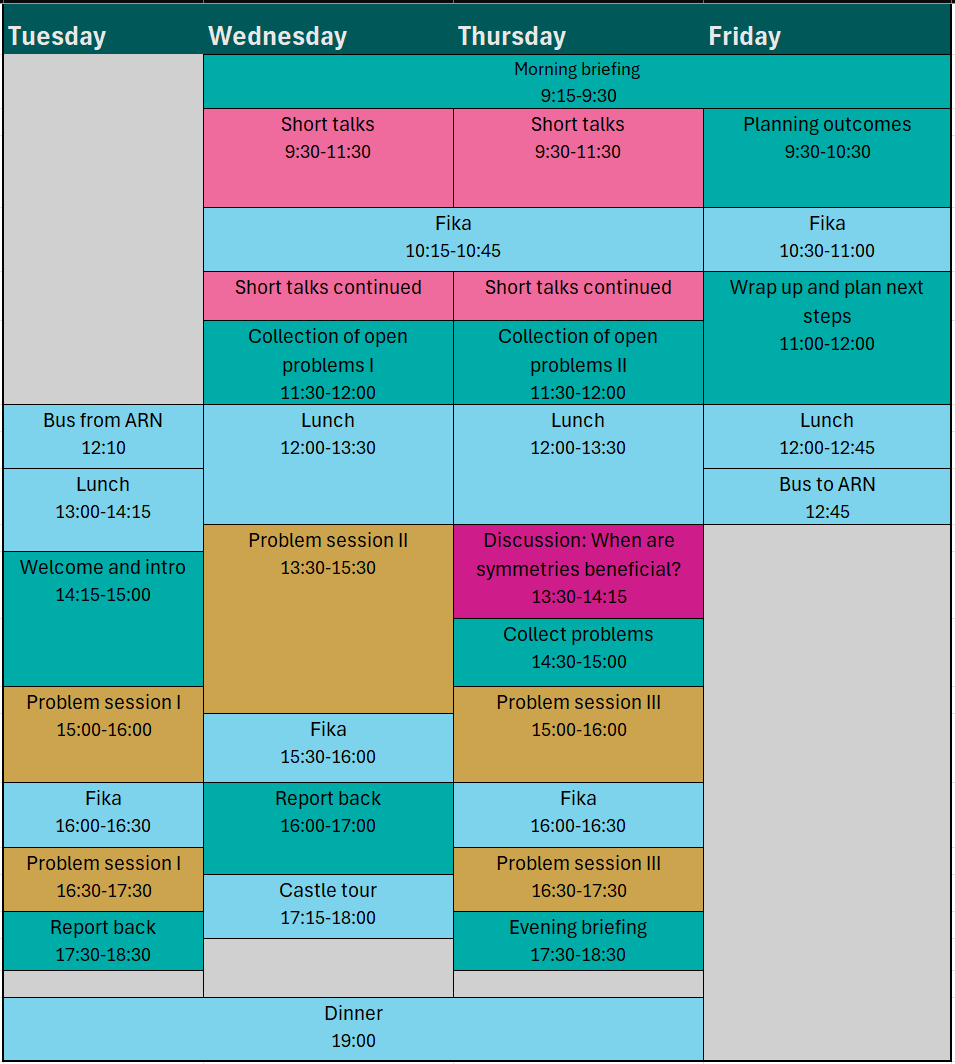
Schedule
The schedule is tentative and subject to change, except from the starting time on Tuesday and end time on Friday.